Shaking off the impact of Nigeria’s subsidy reforms, the BUA chairman is raising cash, with big plans for cement, food and energy production.
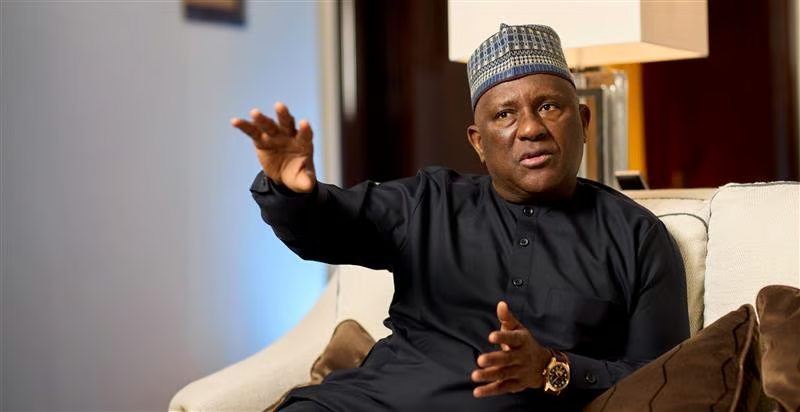
It has been a tough 18 months for businesses of all stripes in Nigeria. Reforms to remove the fuel and naira subsidies, and the subsequent explosion of inflation, have hit citizens and consumers hard.
“It was obviously painful,” says Abdul Samad Rabiu, the chairman and CEO of BUA Industries, a leading conglomerate with interests across cement, sugar and logistics. “But look at what was going on.” Nigeria’s fuel, “then the cheapest in the world”, was sold across the border, subsidising the region.
Rabiu recalls a state banquet where President Mohamed Bazoum of Niger, since deposed, explained why Niger’s refinery only produced diesel. “Bazoum told me: ‘Why should I produce [petrol] for 70 cents when I can get it for 20 cents?’ And he was laughing,” says Rabiu, who adds that importing Niger’s diesel into Nigeria was banned.
With the end of the subsidies, “Nigeria is at its actual consumption, down from 55m to around 20-25m litres”, says Rabiu. “We needed to do these things. Same with the forex. You buy forex for N500 [$0.0064] from CBN [Central Bank of Nigeria]. You go outside, it’s N800. Everybody was going to the central bank to lobby for dollars.”
Despite the turmoil of recent years, Rabiu has not tucked his horns in. His BUA Industries raised $500m in 2023 from the International Finance Corporation, African Development Bank and others, to plough into two new lines at his Sokoto plant.
“In the north, we are the only big plant. It is a huge operation, we are doing about 500,000tn per month,” Rabiu says. With cement at around $120/tn, this amounts to $720m in yearly revenues from BUA’s northern operations. With the new road-building programme announced by President Bola Tinubu, and increasing uptake of cement roads, BUA is well-placed.
Food, energy sectors
Cement expansion is just the start of the new wave of BUA’s growth. In November, BUA announced a $200m facility with Afreximbank to support expansion across a range of industries.
Rabiu says much of that is earmarked for BUA Foods, the agribusiness division listed in 2022 at around N40 per share and now trading at around N350. BUA Foods posted a 25.41% rise in pre-tax profit in the first half of 2024, reaching N137.189bn.
“By 2026, we are going to be the biggest in the country in terms of production,” says Rabiu. “We will have around 10,000tn of flour milling, and 20 lines of pasta.”
Will BUA Foods start creating consumer products, which is where companies like Nestlé make their biggest margins? “Definitely, what we are doing is building capacity, we will go down the consumer packaging and taste route in time.”
For now, a more humble container is needed for BUA’s flour, cement and sugar: bags. Part of the $200m Afreximbank facility will go towards a new bagging facility. “It’s for security,” says Rabiu. “Right now we are outsourcing – and we need about 20m tonnes per annum; that is 400m bags every year”.
Security of supply is a concern for entrepreneurs big and small in Nigeria, where the state is unreliable. Energy is top of the list for most businesses, especially in power-hungry industries like cement. “You cannot depend on the grid or third parties,” Rabiu says. BUA is building a small-scale liquefied natural gas facility (mini-LNG) to help power the new Sokoto cement lines.
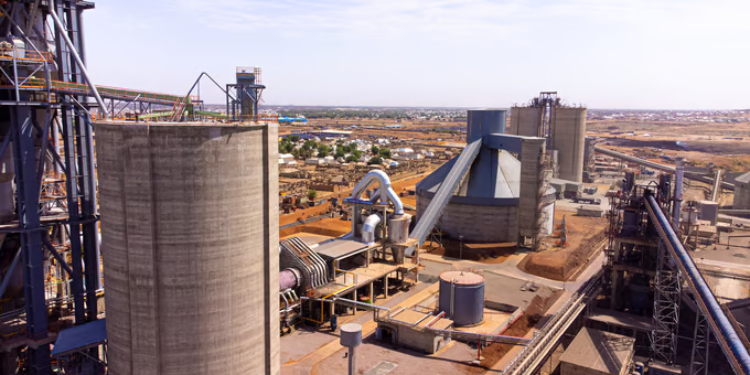
BUA Cement (Sokoto) Plant, Kalambaina, Sokoto State (supplied) © Supplied
A new gas-purchasing agreement is in place for the 700tn/day plant, which is expected to have excess capacity that can be sold once BUA’s energy needs are met – not unlike a corporate-scale version of a household in Lagos that purchases a generator and sells excess power to its neighbours.
“Sokoto is dependent on gas, and that takes around 400tn/day. We can use the remainder in our Rivers State projects and then possibly sell to others,” says Rabiu.
The mini-LNG project is emblematic of Rabiu’s trademark mixture of strategic caution and opportunism. Although BUA Cement is Nigeria’s second-largest cement producer, Rabiu is a relative newcomer. Before 2008, he was trading other commodities; he only entered the cement industry 20 years after the founding of his company in 1988.
Limited imports allowed
Rabiu explains how former president Umaru Musa Yar’Adua tried to resolve issues from his predecessor’s ‘backward integration’ industrial policy in cement. Olusegun Obasanjo had decreed no one could import cement unless they produced locally. While the policy represented a stimulus for domestic producers in the long term, in the short term, prices spiked dramatically.
“Nigeria was producing about four million tonnes a year, while demand was over 10m. There were a lot of complaints,” Rabiu says. Pragmatically, Yar’Adua chose to allow limited imports, selecting six companies, BUA being one, who could import cement if they showed serious manufacturing plans. This did not solve the issue, because landing cement requires a special bulk terminal – not much cement is transported in bags.
“Everybody was in a quagmire. Those with a terminal were enjoying the monopoly,” says Rabiu. “Building a terminal would have taken two years, so why don’t we use a floating terminal? It’s like a factory on a ship. I took the concept to the president, and he said: ‘Good idea. Get on with it.’”
At the time, with cement at $250/tn, it was the making of the BUA fortune, enabling Rabiu to buy Sokoto Cement and expand. “Today we are 17m tonnes per annum,” he says.
Despite being opportunistic, Rabiu is rarely a first mover. While he enthusiastically signed up French petrochemical engineers Axens to be the design partner for a refinery in 2020, four years later, he is still in the ground-clearing phase, preferring to learn from what other players in the sector are facing.
The Dangote oil refinery – a 650,000 barrel per day, $20bn mega-refinery – took almost two decades to complete and is yet to run at full capacity. One of the challenges Dangote faced was the coherence of project execution – several different contractors, each doing different pieces, which led to project-management issues.
Rabiu does not want to comment on Dangote’s travails – the pair occasionally exchange broadsides in the Nigerian media – but he does point to his own experience with turnkey contractors. He recalls flowsheet technology and service supplier FLSmidth, who helped him set up his first cement line in Edo State.
“When we signed with them, we had to buy the equipment from them and then had to get a civil engineering company to do the construction. We had to get another company to do the erection. So it was chaotic, and very expensive, and it took time.”
China’s turnkey bonus
“After that, Chinese companies approached us. The beauty [of] working with them is that everything is turnkey, they do the operations management, they do the mining, everything,” he says.
That is partly why the refinery project is taking longer, says Rabiu, who admits that initially he had wanted to build the refinery in small clusters with contractors for each section.
“Even if it is a little bit more expensive, it is better to have the EPC [engineering, procurement and contracting] as one package.” An example is a real-estate project he is trying to finish in Lagos, involving three different contractors: “The project has stopped because they are all fighting.”
In addition – again, possibly from having watched rival Dangote get ensnared in a fight over access to Nigerian crude – there has been a tweak in the design. It will now allow for different, heavier kinds of crude to be processed by the refinery rather than depending on Nigeria’s sweet-grade crude.
Rabiu refuses to be drawn too far on timelines. “Before 2030, inshallah,” he says. “After Covid-19, everyone wanted to get their hands on engineering and equipment companies, so it’s a tight market.”
Another area where Rabiu might be practicing his ‘next-mover’ strategy? Fertiliser. “It’s a no-brainer – we have the gas,” says Rabiu, referring to Nigeria’s 200trn cubic feet of reserves. “And fertiliser costs $500/tn in Nigeria.”
 2nd-4th June 2026 | Lagos Oriental Hotel, Victoria Island, Lagos, Nigeria